It’s interesting to me that my last post was about rain. As I write this today, it has rained many consecutive days where we live. I’ve seen friends post pictures of leaks and innovative ways of how to handle them. It has also caused mudslides and flooding. It really has been awful in a lot of ways. Still, there have been jokes. There are Ark memes and Ark jokes. My dad called and left a message today. He said he wanted to know if we needed any water.
Sometimes, there’s no rhyme or reason why things happen. Rains and snow in winter doesn’t help droughts in summer. There are times in which I think I haven’t done something enough. Maybe I’ve not prayed enough, read enough, stayed in the Word enough, etc. Really, that’s mostly a deficit mentality. Yet, I fall into it. Thankfully, my wife reminds me that bad things just happen. There are other times in which I get tenacious about whatever it is and decide I won’t be defeated.
What do you do when bad things happen? How do you break the cycle of negativity? Do you fall into a deficit mindset and operate out of weakness? Or do you power through? What helps?
If you find yourself often stuck in negativity, there are some things you can do to break the habit.
It starts with your mind. Let’s look at a couple of verses. Romans 12:2 cautions about living in and of the world. We’re challenged to renew our minds, which will transform us. The next part is particular. Different translations obviously differ. Some use “prove” instead of “testing.”
These days, everything seems connected with testing in some form or fashion. At my work, I counsel students about test anxiety more and more frequently it seems. Testing means something. To be licensed counselor, I had to pass a national test. Nurses have to pass tests. Lawyers do, too.
“. . . that by testing you may discern the will of God . . .” Sometimes, we’re tested; sometimes, we test. Tests shape and teach; they reveal. When we accept Jesus, we are changed people. That change begins on the inside but must push through, permeate, and persist on our outside lives as well. That way, we can tell others what God has done for us.
I think it’s too easy sometimes to forget just what God has done for us. But, we do. It’s in our DNA (i.e., it “Does Not Apply” to me). We focus on what is in front of us rather than remember what God has given us. Our vision is narrow, myopic even. It is hard to see past our noses. It’s not that intentionally try to forget all that God has done. We simply become consumed with ourselves, our stuff, our issues, or our way.
To break the cycle of negativity, we need to remember that we are renewed. In his book, What on Earth Am I Here For?, Rick Warren identifies steps to temptation. First, there’s a desire. We think about something that is tempting us. This could be a number of things. We try not to think about whatever it is. The more we try to do that, the harder it is to think of anything else. Then, Warren says we begin to question or doubt the truth about sin. Make no mistake: Sin separates us from God. We must never forget or doubt what God has done or said. Next, we are deceived. Perhaps, we deceive ourselves, or perhaps (just as Adam and Eve were deceived), Satan deceives us. Maybe we think we deserve this or that, or maybe we tell ourselves, “A little won’t hurt.” Or, “It’s just ____.” Be careful with key words such as “just” or “only.” They just happen to be justifications lots of times. Finally, the temptation is too much and we give in; we disobey. What started as an idea became an action. The thought happened. We felt something. Then, we acted. This is basically the Cognitive Triangle; however, it’s laid out more or less Biblically.
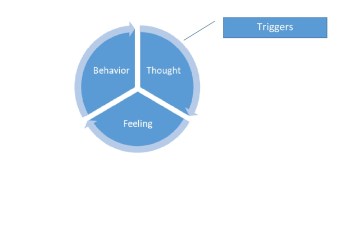
I often talk to my students and clients about triggers. Triggers set us off. They’re likely going to happen early on in the thought process. Examples of triggers are kind of like nouns in that they can be a person, place, or thing. Sometimes, it can be a person who simply reminds us of someone else through their words or actions. It helps to know them.
Like with everything else, the key is early intervention. With illness, intervene early; feel better fast. Mentally, it’s basically the same thing as well. I think it helps to know what our weak spots are. We need to know where we may need help. We need to know people we can contact. We need to know the signs and symptoms of our negative cycle. We need a game plan. What can we do when we spiral downward? On paper, it’s simple, really. In practice, it’s not always easy.
- Seek God.
- Know God.
- Trust God.
For one, we can seek God first. Sometimes, it’s easy to forget that we don’t have to go about things on our own. We have help. When we’re in stuff—the muck, mud, thick of it all—it’s hard to see beyond it. But, God is there. We are promised rest if we go to Him. God’s peace is beyond our understanding. Pray. Prayers builds our relationship with God. Prayer opens the pipeline. Prayer develops. We don’t just pray for ourselves and our junk. We pray for others. One of the quickest way to get out of our funk is to consider other people. Think about it.
Next, we need to know God. Look at what prayer does. Prayer lets Christ in our hearts. We need to let Christ take root in our lives. Build our foundation on solid ground. As it stated in Colossians 2:7-9, we must let Christ be alive in us. God gave me this thought once, but how can anyone see Christ in us if we’re so full of ourselves?
HOW CAN ANYONE SEE CHRIST IN US IF WE’RE SO FULL OF OURSELVES?
How do we get to know God? Well, we need to read and study the Word. Find ways to get into the Word. There are tons of apps available. YouVersion comes to mind. You can set up reading plans, read the verse of the day, study particular subjects in devotionals, etc. For smartphone users, it’s really senseless not to have this app.
In knowing God, we need to be around like-minded people. Christ had 12 disciples but truly and closely associated with three. Have your select few whom you can talk about your struggles, pray, and seek prayer. There is power in hearing from your brothers and sisters what Christ is doing in their lives. There is power in being able to share with your brothers and sisters what He is doing in your life, too.
Finally, we need to trust God. God keeps His promises. God’s gift of grace saves us through faith. It takes faith the size of a mustard seed to move mountains. How big is your mountain? What mountains have you faced that is bigger than the power of God Almighty? We must not forget the power of I Am, of Emmanuel—God with us.
God may not remove your problem. Remember: Sometimes, we are tested to grow. Growth hurts. It’s called growing pains for a reason. We must remember, though, that God is with us and will not forsake us. He keeps His promises.
Communicate with God daily. Read, study, and learn as much as you can. Get in the Word. Surround yourself with fellow believers. Finally, trust Him. Once you accept Jesus, He’s with you. Don’t fall for the lies you or others tell you. Seek the truth. Stay grounded in it. If you don’t know what to say, start with, “Jesus.”
Thanks for reading!
Jason
#negativity #cycle #triggers #Jesus #Faith #Trust
 dr. jason newcomb
Leave a reply to Right Now – Christ-led Leadership Cancel reply